
Poverty in Mauritius in 2026: what the figures show and what lifts a family out
More than 100,000 Mauritians live below the relative poverty line. After more than fifteen years in Rose-Belle, Atelier Sa Nou Vize has seen two things move a family out of poverty and keep it out: a full education and a sound roof.
What the latest figures say
The 2023 Household Budget Survey counted about 101,900 people below the relative poverty line, which then stood at Rs 12,378 a month. Statistics Mauritius published its poverty analysis of the survey in 2025.2 The measure is relative: a household counts as poor when its income, adjusted for its size, falls well below that of the typical household.
The trend is good. IMF staff working from the same survey found that the share of households in relative poverty fell from 9.6 per cent in 2017 to 7.3 per cent in 2023, while real household income rose by about 22 per cent. Inequality narrowed as well, with the household Gini coefficient dropping from 0.40 to 0.33.1
Households below the relative poverty line
Share of all households in Mauritius
Read those numbers with care. A family a few hundred rupees above the line still has to choose between the electricity bill and school shoes. And the national average hides Rodrigues, where poverty and inequality both run far higher than on the main island.
Why transfers alone cannot hold the line
The IMF puts much of the fall down to fiscal policy: higher pensions, new allowances and bigger social transfers after the pandemic. That came at a price. Public debt rose by almost 30 points of GDP between mid-2019 and mid-2025, to around 90 per cent of GDP, and the Fund now wants benefits targeted more tightly and the tax base broadened.1
Tighter targeting makes sense: the same report shows that most people receiving several of the allowances live above the poverty line. At the bottom, though, income held up by transfers rises and falls with each budget. When a budget tightens, the household that relied on it slips back. What a family keeps from one budget to the next is what its members can earn, and the house they sleep in.
This year the rules changed again. From January 2027 the Basic Retirement Pension becomes the State Age Pension. A means test announced with the June Budget was frozen three days later after a public outcry, and the monthly income support of Rs 10,370 for people aged 60 who do not yet draw a pension ends in December 2026.56
For working-age families, targeted help runs through the Social Register of Mauritius (SRM). Its income ceilings rose in July 2026 and go up again in July 2027.5 Households left off the Register lose their CSG income and child allowances by 30 June 2027. Registered households keep them in full.7
Highest monthly household income that qualifies for the Social Register
Per adult: Rs 3,575, then Rs 4,000 and Rs 4,250. Per child: Rs 2,500, then Rs 2,800 and Rs 3,000.
Education: the clearest dividing line
In the 2023 survey, households whose education stopped at primary level had a poverty rate of about 11 per cent. With upper secondary education the rate was around 2 per cent. Pay follows the same line: upper secondary graduates earn about 62 per cent more than people who never finished primary school.1
Poverty rate by household education level
Share of households below the relative poverty line, 2023
The damage starts long before secondary school. A child who reaches Grade 1 without ever having held a pencil, in a home where nobody can help with homework, falls behind in the first two years and seldom catches up.
Poverty pushes children out of education at precise moments: before school begins, in the early grades, at homework time, and in adolescence, when talent has no coach and a small wage pulls hard.
Atelier Sa Nou Vize has built its programmes around those moments. Atelier des Tout-Petits takes children from three months to three years, free of charge and with three meals a day, so that their mothers can work or train. Its 18 places are full and about 40 families are waiting. Atelier des Premiers Rêves, a free pre-primary school for children aged three to five, is due to open in January 2027. Workshop of Hope gives after-school tutoring in Mathematics, English and French from Grade 1 to Grade 13, to around 50 students every weekday across our three centres. On Saturday mornings the Youth Development Academy offers dance, choral singing, football and basketball, also free.
Continuity counts for as much as any one programme. A child who started at our crèche can still be known by name in tutoring ten years later, and the person who manages Atelier Sa Nou Vize today was once a Workshop of Hope pupil.
Housing: the roof that decides the rest
Nobody can do homework in a room where water comes through the roof every cyclone season, and the survey shows how common that is. About a quarter of Mauritian households report roof or wall leaks each year. IMF analysis of the 2023 data finds that a concrete roof sharply lowers the chance of a leak. Repairs cost a typical household around US$500 a year, roughly 3 per cent of its income, and only 4 per cent of owner-occupiers hold house and contents insurance.1
For the poorest families the queue for a proper home is long. When the National Audit Office reported in 2021, 25,582 households were waiting for a National Housing Development Company unit; 30 per cent had waited more than ten years, and 7,961 households more than twenty.3 Delivery has picked up since. By July 2026 the New Social Living Development counted 2,352 units across 12 sites, with 292 sets of keys handed to families.4 The 2026-27 Budget adds Rs 2 billion for off-site infrastructure under phase one of an 8,000-unit social housing programme.8
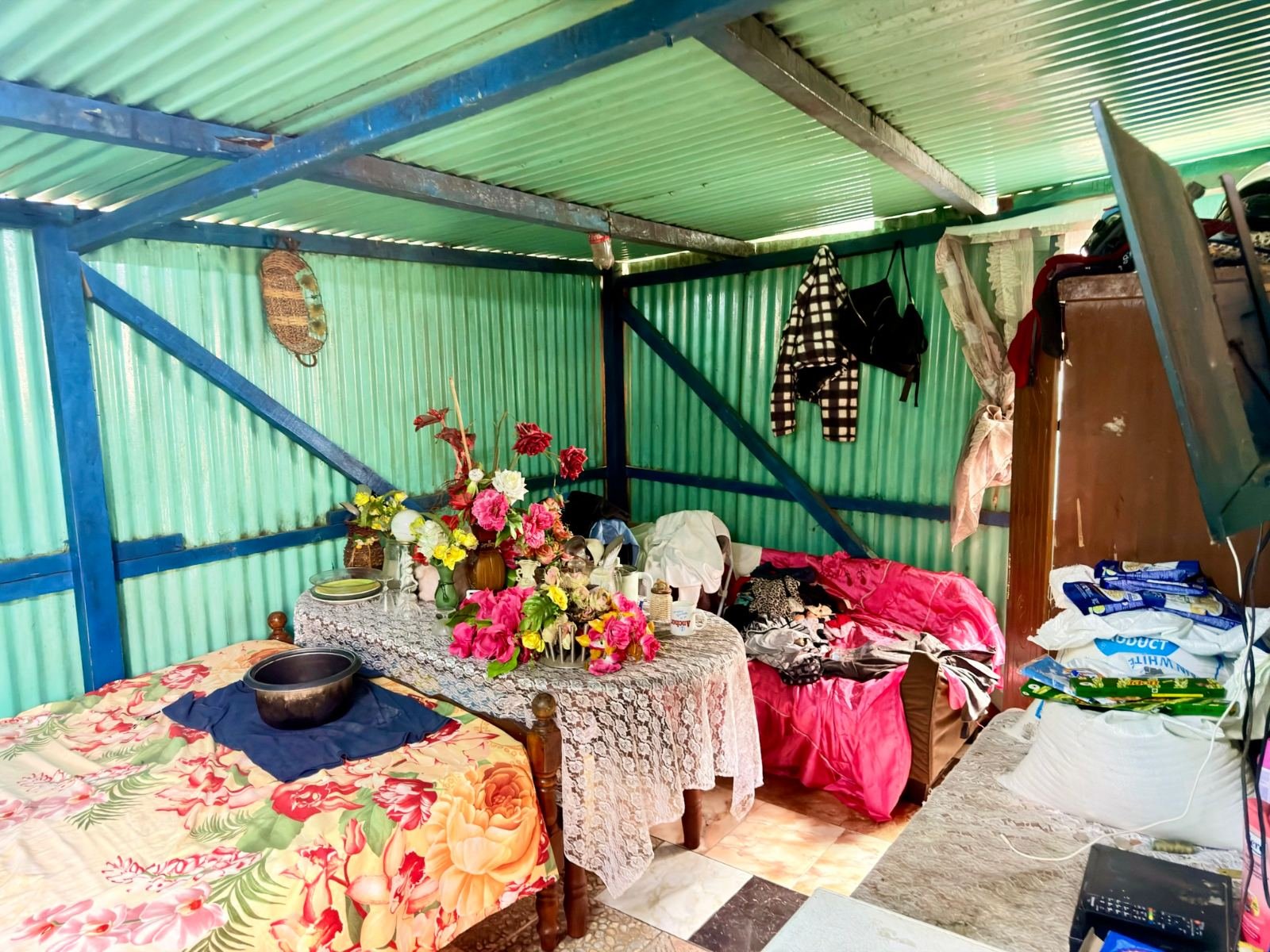
In Rose-Belle, families still live under corrugated iron. Since 2010 Atelier Sa Nou Vize has repaired or improved more than 60 family homes, and this year we took down one such iron-sheet house, home to a single mother and her five children. It was one room: a bed, a table under a lace cloth, a wardrobe and the family’s sacks of provisions, all beneath green sheet iron with daylight showing at the joins. A two-storey reinforced concrete house is now going up in its place. A dry, secure home is where schooling becomes possible, with a table to work at and a night’s sleep the rain does not break.
Iron sheet is not the only problem in Rose-Belle. Résidence Bethléem, where Atelier Sa Nou Vize began, is a former EDC estate, one of the cités built after cyclones Alix and Carol in the 1960s. Many of those houses went up in asbestos cement, a material linked to asbestosis, lung cancer and mesothelioma.9 In 2013, about 50 of the estate’s 125 or so houses still had asbestos walls.10
We have been getting families out of them ever since. In 2010 a construction project with our partners helped more than 40 families leave asbestos houses. Four or five more followed each year until 2020, among them about ten homes rebuilt in 2019-2020 with funding from the National Social Inclusion Foundation.11 Today 32 asbestos units remain in Résidence Bethléem. We work with the families who still live in them.
Asbestos houses still standing in Résidence Bethléem, Rose-Belle
Number of housing units
Across the island, the state counts between 1,453 and 1,560 homes that still contain asbestos, and the housing minister, Shakeel Mohamed, has admitted that its own figures do not agree.9 In May 2026 Parliament voted to demolish the remaining asbestos social houses.12
An interministerial committee is to handle rehousing, rebuilding and demolition. Families could swap their plot for a new social home, or rebuild on their own land with a Mauritius Housing Company loan or direct aid. Air quality is to be tested in 35 houses, and Statistics Mauritius is to draw up a new national inventory. Rebuilding is put at Rs 2.5 to 3 million per unit.9 The unions, who have campaigned on this for decades, want to see the bulldozers before they celebrate.12
What can be done
The figures show where effort pays off. Free, good early childhood care in the poorest neighbourhoods lets mothers work now and gives children a fair start at Grade 1. Tutoring that follows the same children from the early grades to School Certificate and Higher School Certificate keeps them in school long enough to join the households with a 2 per cent poverty rate. Replacing iron-sheet roofs and asbestos walls with concrete protects the house and the schooling that goes on inside it. Mauritius is already looking for climate finance to adapt its housing to stronger cyclones, and that money should reach the families under corrugated iron and asbestos first.
Frequently asked questions
How many people live in poverty in Mauritius?
About 101,900 people lived below the relative poverty line of Rs 12,378 a month in 2023, according to the Household Budget Survey.
Is poverty in Mauritius falling?
Yes. The share of households in relative poverty fell from 9.6 per cent in 2017 to 7.3 per cent in 2023, helped largely by social transfers that are now under budget pressure.
How does education reduce poverty in Mauritius?
Households with upper secondary education have a poverty rate of around 2 per cent, against about 11 per cent for households whose education stopped at primary level.
How can I help poor families in Mauritius?
Give to, sponsor or volunteer with an accredited NGO. Atelier Sa Nou Vize has been accredited by the National Social Inclusion Foundation since 2017 (registration NCSRF/2017/0178), and its accounts are audited every year.
Sources
- International Monetary Fund, Mauritius: Selected Issues (2025), based on the 2023 Household Budget Survey.
- L’Express via AllAfrica, « Plus de 100 000 Mauriciens vivent dans la pauvreté » (October 2025).
- L’Express, “Housing crisis: the state’s poor delivery of social accommodation” (2021), citing the National Audit Office.
- PropertyCloud, “From Concrete to Keys in Social Housing” (August 2026).
- Government of Mauritius, Annex to the Budget Speech 2026-2027, sections 23 and 27 (June 2026).
- Bloomberg, “Mauritius Halts Pension Means-Test Plan After Public Backlash on Budget” (22 June 2026).
- Government of Mauritius, Annex to the 2025-2026 Budget Speech (June 2025).
- Budget Speech 2026-2027, National Assembly, paragraph 172 (19 June 2026).
- Top FM, « Amiante : l’État enclenche enfin un processus pour les familles des ex-cités CHA » (2026).
- Le Mauricien, « Lindsay Charnier chante pour Résidence Bethléem » (August 2013).
- Act Together, “Atelier Sa Nou Vize (Mouvement Forces Vives, Quartier EDC, Rose-Belle)”, NGO profile.
- IndustriALL, “Mauritius slowly moves to demolish asbestos legacy” (19 May 2026).
About Atelier Sa Nou Vize. A community NGO working in Rose-Belle for more than fifteen years, running free early childhood care, tutoring, youth activities and home repairs. Accredited by the National Social Inclusion Foundation since 2017.